ROBOTICS CLUB 2025-26
REPORT FOR FIFTH ACTIVITY
22nd November 2025
The Robotics Club aims to introduce young learners to the exciting world of science, technology, engineering, and mathematics (STEM) through hands-on robotics activities. Throughout the academic year, students participated in a variety of tasks designed to inspire creativity, promote critical thinking, and foster collaboration. TinyBots, an initiative by ES Solutions Pvt. Ltd., is committed to sparking students’ curiosity about science. The fifth activity in this series was conducted on 22nd November in classes X-B, X-D, and in the Computer Lab. TinyBots focuses on nurturing children’s natural curiosity and encouraging their interest in science through a well-structured, activity-based robotics workshop designed for students in Grades VI–VIII.
Objective:
* To build a strong pool of students equipped with advanced technical skills, preparing them for immediate roles in research and industry.
* To introduce learners to the latest advancements in automation and manufacturing technologies.
* To offer real-time, hands-on training that enhances students’ expertise in cutting-edge technologies, enabling them to excel in the global arena.
* To provide enthusiastic students with opportunities to showcase their skills, knowledge, and creativity by conceptualizing, designing, and programming robots.
Level 1 –
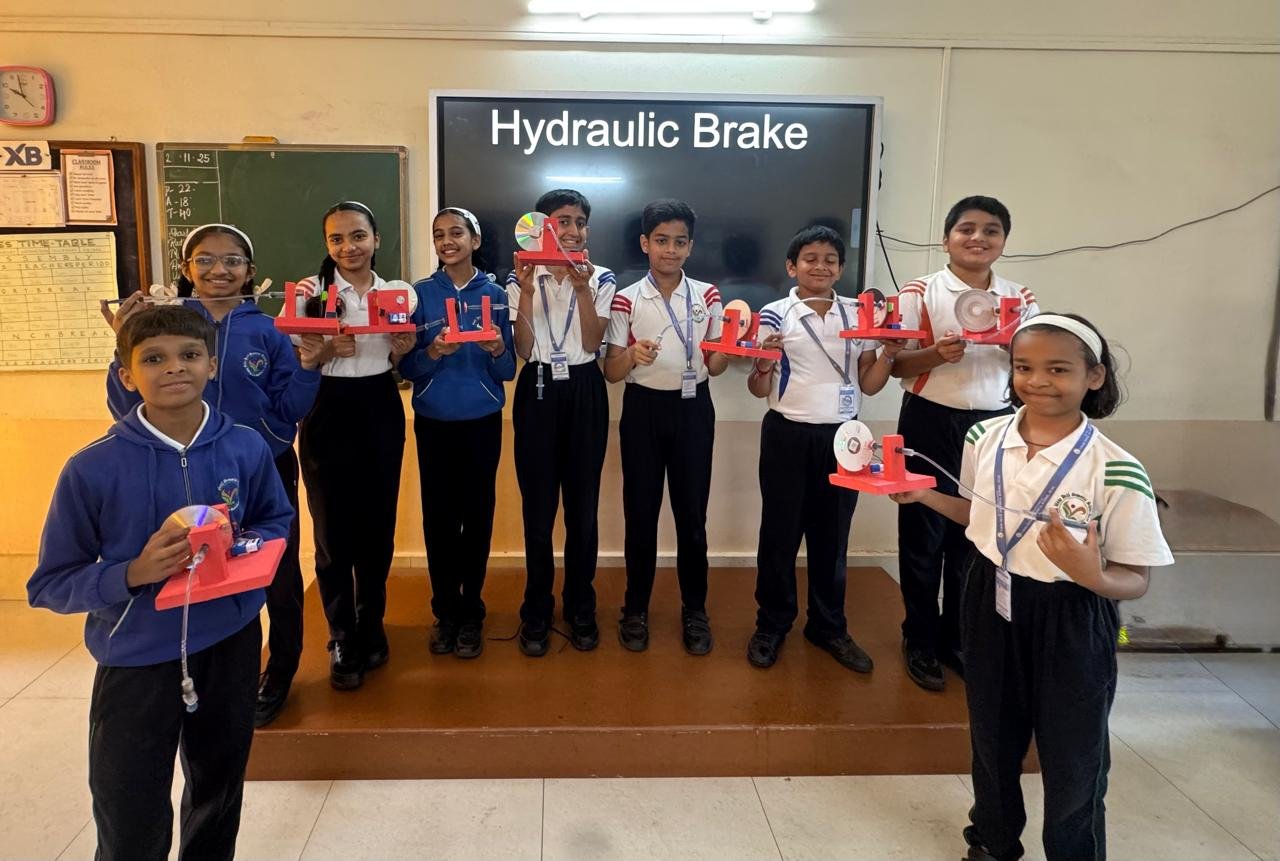
Activity 1:- Hydraulic Brake
Objective- To understand the principle of Pascal’s law and how hydraulic systems multiply force to transfer motion efficiently.
When the switch is pressed the motor works and starts spinning the CD. Here the CD resembles the wheel of vehicle. When the plunger of the lower syringe is pressed, it pushes the plunger of the upper syringe towards the rotating CD and reduces its speed. If pressed further it stops the CD from rotating. Here Pascal’s law (hydraulic pressure) is brought into use. It states that the external pressure applied to a fluid in a closed vessel is uniformly transmitted throughout the fluid. In this model the fluid (water) is pushed in a syringe which in turn tries to find space and hence moves anything which comes in its path.
Activity 2:- Demo of Pick and Place Robot
Objective- To explore basic robotics, mechanical gripping mechanisms, and controlled actuation for performing pick-and-place operations.
A pick-and-place robot detects an object using sensors or a vision system, then moves its robotic arm to the object’s location using programmed coordinates or real-time tracking. The gripper or suction end-effector lowers, securely grabs the object, and lifts it from the surface. The robot then follows a calculated path to the target location, ensuring smooth and collision-free movement. Once positioned, the gripper releases the object accurately at the desired spot, and the robot returns to its home position to repeat the cycle.
Level 2-
Activity 1:- Blender / Whisker
Objective- To understand rotary motion, mechanical mixing, and how motor speed affects the blending or whisking process.
A blender or whisker works using an electric motor that spins a set of blades or beaters at high speed. When switched on, the motor transfers its rotational energy to the blades, causing them to cut, mix, and circulate the ingredients. In a blender, the sharp blades create a strong vortex that pulls food downward for continuous chopping and blending, perfect for smoothies, purées, or crushing ice. A whisker, on the other hand, uses rotating beaters to trap air into mixtures, making it ideal for whipping cream, beating eggs, or mixing batter. Both devices rely on fast, continuous rotation to achieve smooth and uniform mixing.
Activity 2:- Aarti / Pooja Robot
Objective- To learn about motor mechanisms, rotation control, and how automation can be used for cultural and devotional applications.
The motor’s shaft rotates which in turn rotates the Z shape clamp. The L shape clamp needs to be stationary. The red LED resembles the Diya. The fixture of 2 nuts used to fix the 2 clamps together needs to be loose. The Diya would overturn in case the nuts are tight. In case the robot works in anticlockwise direction, we need to swap the battery connector wires.
Level 3-
Activity 1: Mobile Controlled Gesture Controlled Robot
Objective- To understand Arduino programming, Bluetooth communication, gesture control, and motor driver interfacing.
A gesture-controlled robot moves based on the tilt or motion of a mobile phone. The phone has built-in accelerometer sensors that detect movement. When the user tilts the phone forward, backward, left, or right, the sensor data is sent to the robot using Bluetooth.
The robot has a Bluetooth module, a microcontroller (like Arduino), and a motor driver. The Bluetooth module receives the commands from the mobile app and sends them to the microcontroller. The microcontroller then controls the motors to move the robot in the direction of the gesture.
Report by – Mr. Tejas Kulkarni