Report – Emotional Well Being Activity – Coping Cards Activity
Day & Date: Monday, 27th July 2026
Classes: Std. I, II and III
Activity: Coping Cards – Open When You Feel…
The Coping Cards Activity was conducted on 27th July 2026 for the students of Std. I, II and III with the aim of helping young learners recognise, understand and manage different emotions in a calm, positive and safe manner. The activity was designed to create an emotionally supportive classroom environment where students could openly express their feelings and learn simple strategies to cope with challenging situations.
The session began with a meaningful conversation between the teacher and the students about different feelings that children may experience in their everyday lives. The teacher introduced emotions such as anger, sadness, nervousness and loneliness and encouraged students to think of situations in which they might experience these feelings. Students were given opportunities to share their own experiences and ideas. The discussion was kept interactive, with responses being elicited primarily from the students. This helped them understand that experiencing different emotions is natural and that it is important to respond to these feelings in healthy and appropriate ways.
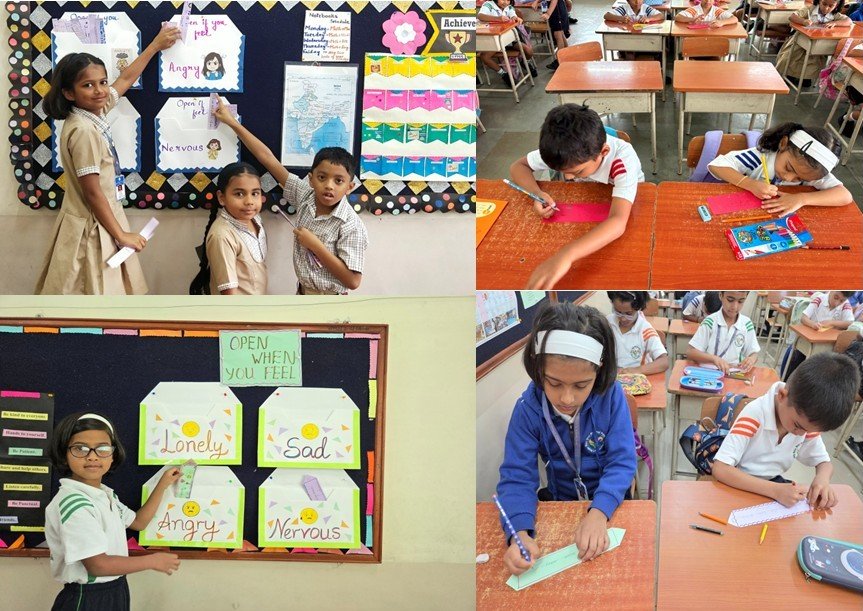
To make the activity engaging and age-appropriate, four large envelopes were prepared and labelled “Angry,” “Sad,” “Nervous,” and “Lonely.” These envelopes were pasted on a chart with the heading “Open When You Feel…” Each envelope represented one emotion and served as a collection of simple coping strategies suggested by the students.
The teacher explained that the students would write one helpful suggestion beginning with the words “I can…” on a slip of paper and place it inside the envelope corresponding to the emotion. Before beginning, students discussed possible responses to each feeling. The teacher provided examples only to guide the discussion and encouraged children to contribute their own ideas.
For the “Angry” envelope, students explored ways to calm themselves before reacting. Suggestions included taking three deep breaths, counting from one to five, drinking water, sitting quietly for a minute, telling the teacher calmly, saying “Please stop,” walking away, thinking before speaking and using kind words. Through these suggestions, students understood that anger can be managed without hurting themselves or others.
The “Sad” envelope focused on ways of seeking comfort and expressing sadness appropriately. Students suggested talking to a friend, telling the teacher, drawing a picture, thinking of something happy, reading a favourite book, playing with someone and taking deep breaths. The activity helped students realise that they do not have to keep difficult feelings to themselves and that talking to a trusted person can make them feel better.
For the “Nervous” envelope, students discussed situations such as speaking in front of the class, trying something new or facing a challenging task. They suggested taking deep breaths, practising once more, saying “I will try,” smiling and starting, asking for help, thinking positive thoughts and reminding themselves, “I am brave.” These responses encouraged students to develop confidence and understand that nervousness can be managed by taking small, positive steps.
The “Lonely” envelope encouraged students to think about ways of connecting with others. Suggestions included asking someone, “Can I play with you?”, smiling at a classmate, talking to the teacher, sitting with a friend, helping someone, inviting someone to play and remembering that they are not alone. This discussion promoted kindness, friendship, inclusion and empathy among the students.
The activity also provided an opportunity to discuss jealousy as another emotion that children may sometimes experience. Students were encouraged to understand that instead of comparing themselves with others, they could say “Well done,” recognise their own strengths and learn from others. This reinforced the importance of appreciating others while being confident about one’s own abilities.
The Coping Cards Activity was not merely a writing exercise; it encouraged students to identify emotions, reflect on personal experiences, and listen to their peers and think of practical solutions. By contributing their own “I can…” statements, students took ownership of their emotional well-being. The activity also strengthened communication, empathy, self-awareness, problem-solving and positive decision-making skills.
The completed chart served as a visual reminder that every emotion is valid and that there are constructive ways to deal with difficult feelings. Students were encouraged to revisit the chart whenever they felt angry, sad, nervous or lonely and choose a coping strategy that could help them feel calmer and safer.
Overall, the Coping Cards Activity was an engaging and meaningful social-emotional learning experience for the students of Std. I, II and III. It helped children understand their emotions in a simple and relatable manner while empowering them with positive strategies to handle challenging moments. The activity reinforced the message that it is okay to have different feelings, and it is important to respond to those feelings with calmness, kindness and courage.