ACTIVITY REPORT
Name of the club: Advanced Robotics
Name of the Activity: Circuit Building on Breadboard and Fundamentals of Arduino Programming with Vehicle Indicator Blinking System
Date: 11th April 2026
Venue: Computer Lab, Junior Block
Resource Person: Mr. Anil Aher, Founder & Director, TinyBots, an initiative of ES Solutions Pvt. Ltd. And team
Objective;
The objective of the activity was to help students understand the basics of electrical circuits, including circuit connections, polarity, and the use of a breadboard for building and testing circuits without soldering. The session also aimed to introduce Arduino programming, explain the role of a microcontroller, and demonstrate how hardware and software work together in smart systems. In addition, the activity was designed to help students understand sequential logic by creating an Arduino-based vehicle indicator blinking system.
Report of the Activity
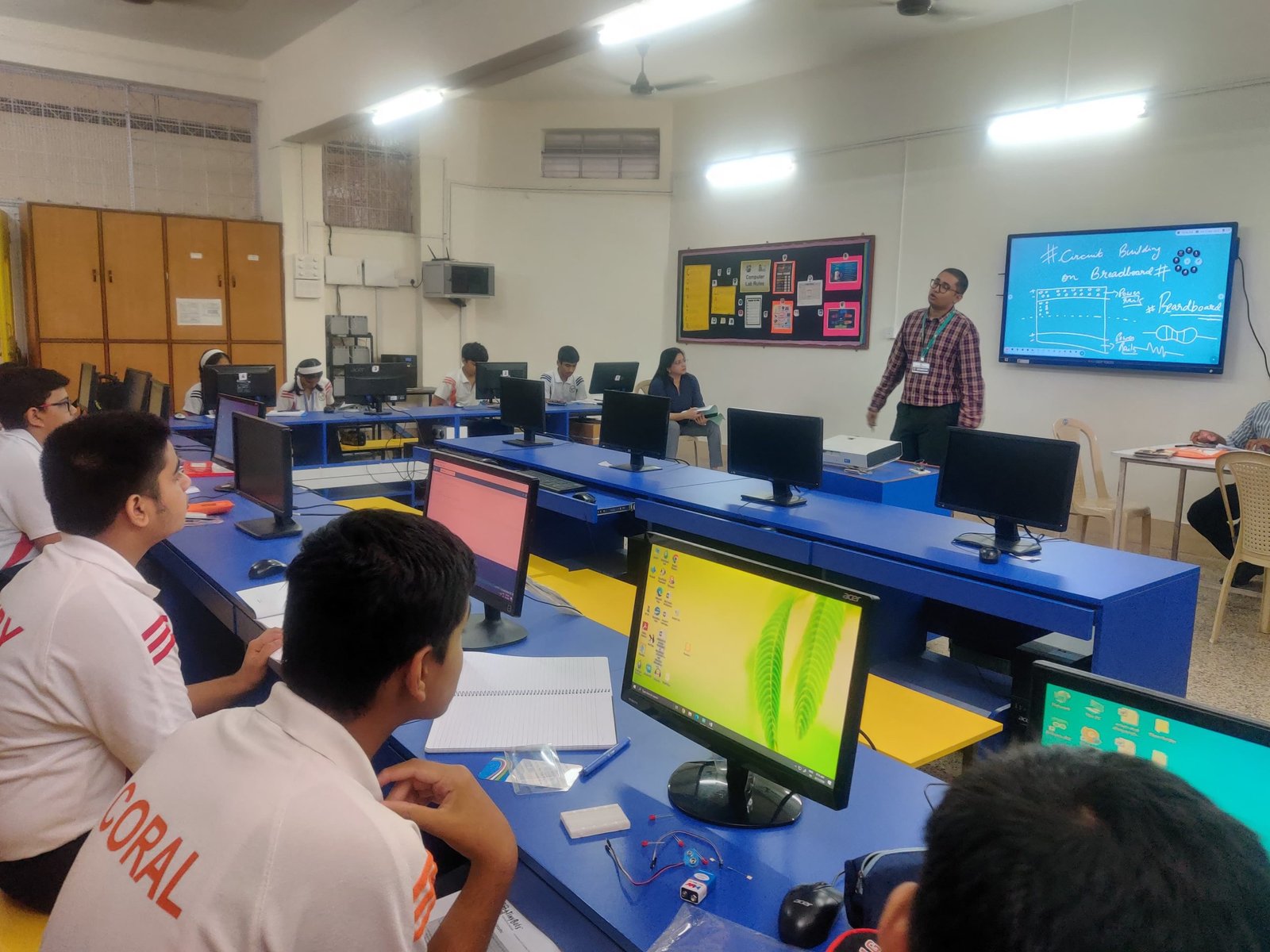
The Advanced Robotics Club organised an informative and practical learning session on 11th April 2026 in the Computer Lab for students interested in electronics, coding, and automation. The workshop was conducted by Mr. Anil Aher, Founder & Director of TinyBots, an initiative of ES Solutions Pvt. Ltd.
The session began with an introduction to circuit building on a breadboard. Students were taught the basic concepts of electrical circuits, current flow, polarity, and the importance of proper connections. They learned how to assemble simple circuits using components such as LEDs, resistors, and connecting wires. This hands-on practice helped students understand how circuits are built and tested without soldering.
The second part of the session focused on the fundamentals of Arduino programming and smart systems. Students were introduced to Arduino as a microcontroller and learned how basic programming commands are used to control electronic components. They also understood how hardware and software interact to develop smart systems and simple automation models.
The highlight of the activity was the development of an Arduino-based vehicle indicator blinking system. Students programmed multiple LEDs to blink in sequence, simulating the working of real vehicle indicators. Through this activity, they gained practical knowledge of sequential programming logic and learned how Arduino can be used to control multiple outputs effectively.
The session was highly interactive and engaging. Students actively participated in circuit assembly, coding, and testing of the model. The activity provided valuable exposure to basic robotics and embedded system design, while also enhancing logical thinking, creativity, and problem-solving skills.
Learning Outcome
Through this activity, students learned how to build simple circuits on a breadboard using LEDs, resistors, and wires. They understood the importance of correct connections and gained clarity about the flow of current in a circuit.
Students also learned how to write and upload simple programs to Arduino and understood how coding can be used to control electronic components for smart applications. By creating the vehicle indicator blinking system, they developed a better understanding of sequencing in programming and the practical use of Arduino in real-life systems.
Conclusion
The activity was successful in providing students with both theoretical understanding and hands-on experience in basic electronics and Arduino programming. It proved to be an enriching learning opportunity for the members of the Advanced Robotics Club and encouraged them to explore robotics and automation more deeply.