REPORT ON SPECIAL GUEST LECTURE ON THE OCCASION OF
WORLD ENVIRONMENT DAY CELEBRATION: CONSERVATION OF SEA TURTULE AND DIFFERENT CAREER OPTIONS
Date: 5th June 2026
Target Audience: Classes X and XII
Occasion: 5th June 2026 World Environment Day
Guest Speaker: Prof. Andrea Phillott (andrea.phillott@flame.edu.in)
Initiated by: Snehan Chauhan (Alumnus, VPMS Pune)
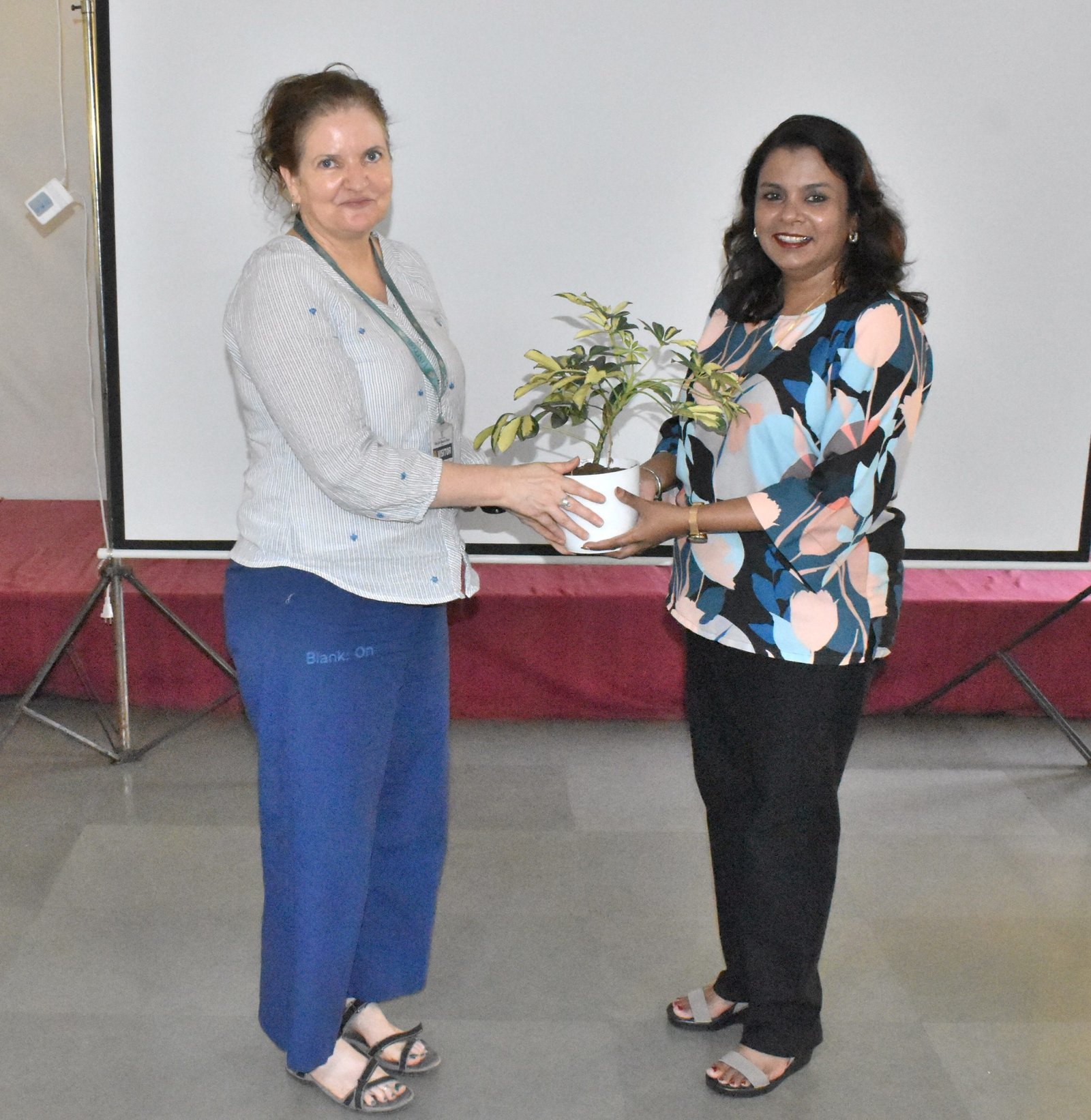
On the occasion of World Environment Day, a highly enriching guest lecture was organised for the students of Classes X and XII on 5th June 2026. The session aimed to build ecological consciousness, explore the delicate balance of marine biodiversity, and introduce students to modern, interdisciplinary academic avenues. We extend our heartfelt gratitude to our Principal, Ms. Mrinalini Fernandes, for granting us the opportunity to host this impactful interaction, marking a meaningful step forward for our school toward a better and greener environment.
The school was deeply privileged to host the eminent guest speaker, Prof. Andrea Phillott, Dean of the Faculty of Liberal Education at FLAME University. As a passionate researcher and an established academic leader, Prof. Phillott brought a wealth of knowledge to the forum. Her background as a resident of Australia uniquely enriched the interaction, giving students a firsthand perspective on global conservation efforts and international marine habitats.
Prof. Phillott initiated the session by discussing the core of her research. The speaker shed light on why the study and protection of sea turtles is a critical indicator of global marine health. She detailed the incredibly perilous life cycle these creatures endure, noting that a female turtle lays roughly 100 eggs which incubate for 7 weeks. Shockingly, due to heavy ecological threats, only 1 in 1,000 hatchlings successfully reaches adulthood. Survival is further complicated by delayed maturity, as it takes anywhere from 15 to 35 years for these turtles to return to their nesting grounds, with certain species in Australia requiring the full 35 years to mature. Throughout this time, they face severe threats from predators like crabs, birds, and dogs that raid their nests, alongside human-induced and environmental hazards such as plastic pollution, severe storms, diseases, and dangerously hot temperatures.
To combat these grim survival rates, Prof. Phillott outlined vital conservation practices and the logistics of hatchery management. Deliberate protective actions include relocating vulnerable eggs to safer locations and enforcing strict beach protection protocols within designated areas. She described a hatchery as a managed facility dedicated to researching, training, educating, and safely producing hatchlings. Successful incubation within these facilities depends on regulating three critical variables: temperature, moisture, and oxygen.
The speaker particularly emphasised the “heat” factor in sex determination, explaining that sea turtle gender is entirely temperature-dependent; high temperatures produce more females,
while low temperatures result in more males. Furthermore, nests in a hatchery are explicitly engineered to mimic natural geometric shapes, which enables the hatchlings to dig upward together as a cohesive group to leave the nest. Conservationists carefully monitor these thermal conditions as hatching nears, ensuring temperatures do not exceed a critical threshold around 33°C.
Prof. Phillott continued the session by establishing a fundamental distinction between two major academic pathways: Environmental Science and Environmental Studies. She explained that Environmental Science relies heavily on core scientific disciplines, such as the physical sciences, biological sciences, and chemistry, to focus on the tangible, empirical components of the natural world. Conversely, Environmental Studies examines the human dimensions of these ecological issues, centring on how society interacts with nature while addressing the cultural, policy, and behavioural shifts required for true sustainability.
The latter half of the session beautifully bridged local ecological action with macro-level developmental goals and higher education opportunities. Prof. Phillott highlighted how local marine conservation aligns seamlessly with global mandates like the United Nations’ Sustainable Development Goals (SDGs) targeted for 2030, as well as India’s G20 priorities that integrate national green growth agendas with global conservation targets.
Concluding her address, she introduced the academic opportunities available at FLAME University, noting that their Environmental Studies program offers a modern, flexible academic framework aligned with national educational policies. This includes a 4-year degree program with a flexible exit option after 3 years, granting students the interdisciplinary freedom to explore up to 240 Major and Minor combinations tailored to their specific areas of specialisation.
The session wrapped up with an engaging Question and Answer segment, where students eagerly dived deeper into conservation logistics and future environmental career pathways.